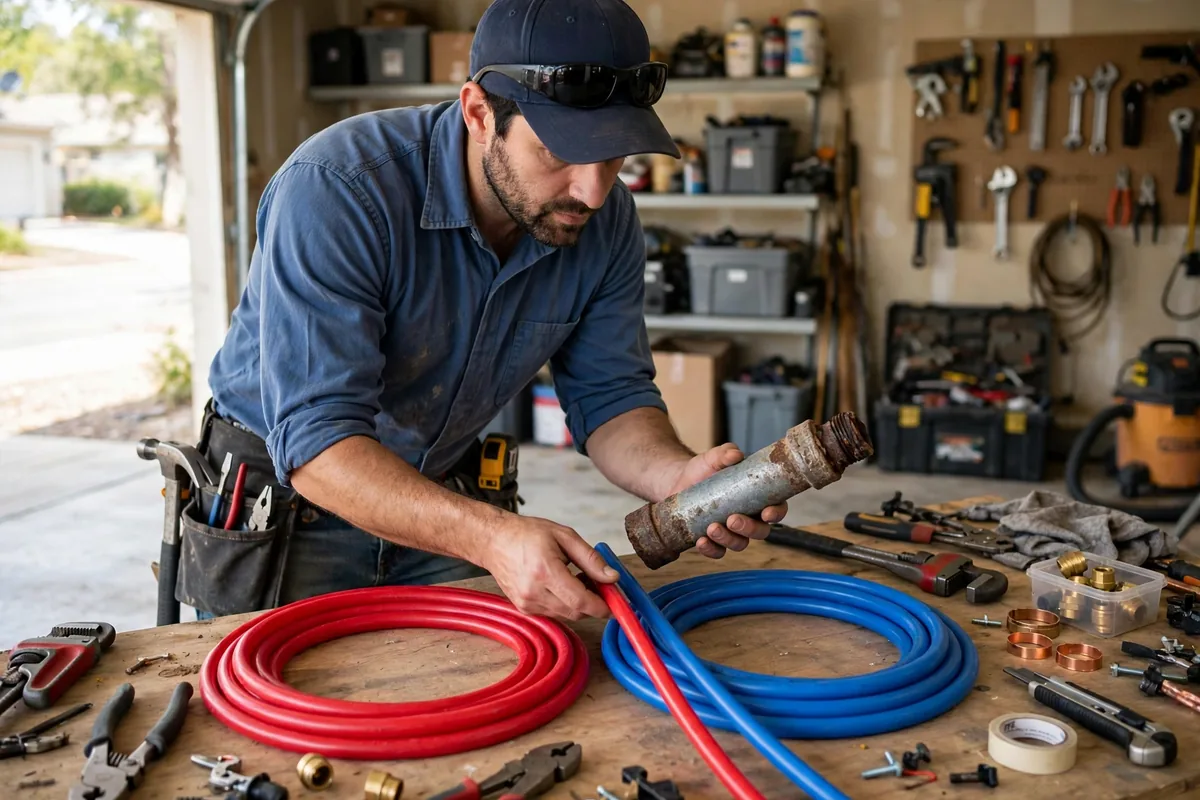
Repiping
When To Repipe A House Instead Of Repairing Another Burst
Not sure how repiping works or what it involves exactly? One free call connects you with a local pro who can arrive in 30–60 minutes. Call now.

Answered 24/7 · Free To Call · No Obligation
Free Call · Answered 24/7 · Local Pros Near You
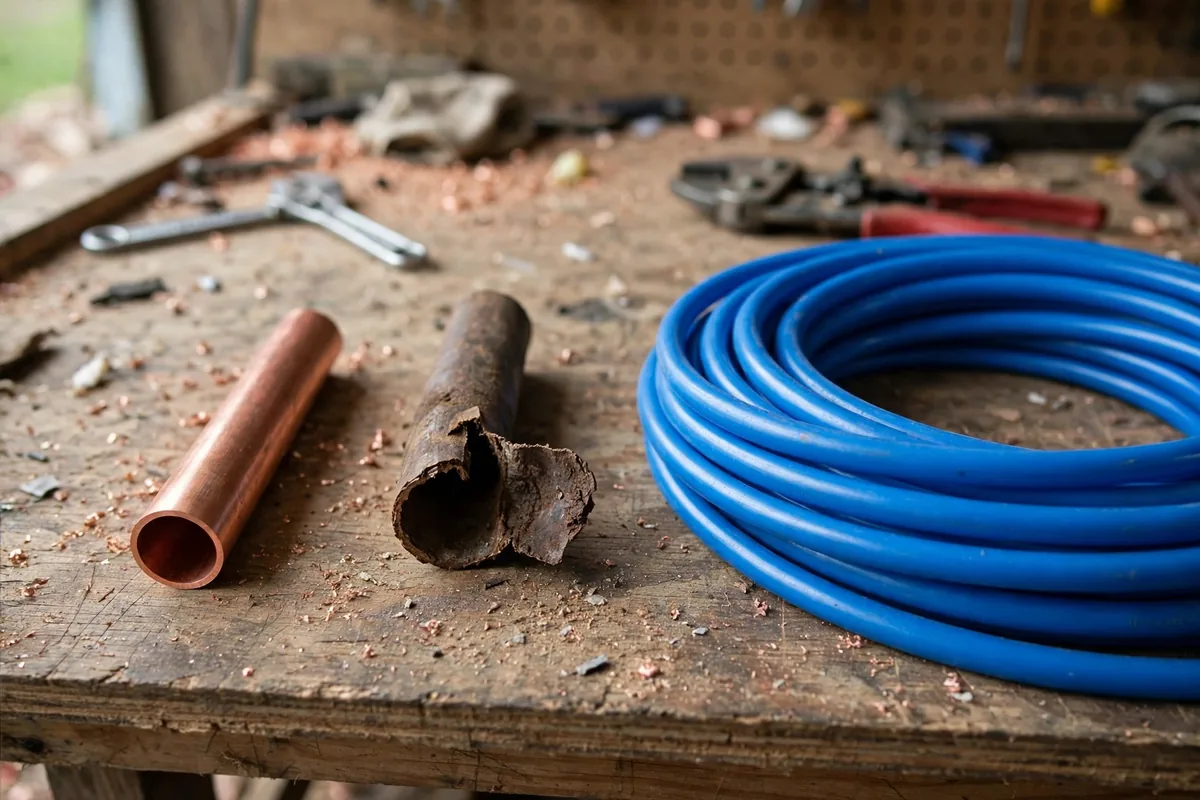
Burst pipe replacement and section repair are the two honest scopes for the same failure, and the pipe itself casts the deciding vote. A section repair — cutting out the split plus a margin of sound pipe — is right when the surrounding run is healthy. Full replacement is right when the cut-out shows the neighbours failing too: thinned walls, scaling, a second weak spot. The evidence is in the piece that comes out; a pro shows it to you.
Every burst ends with the same fork in the road: fix the piece that failed, or replace the run it failed in. Homeowners fear the second answer is upselling; pros fear the first is a promise the pipe cannot keep. Both fears are answered the same way — by evidence. This page lays out what each scope really involves and the signs that should steer the choice, so the decision is made by the pipe's condition rather than by anyone's sales target or anyone's wishful thinking.
A section repair removes the damaged length plus a margin of sound pipe on both sides — the margin matters, because freeze splits and corrosion both extend beyond the visible hole — and joins in the new pipe — a straight pipe coupling here, an elbow there — with soldering, press fitting or push-fit fitting connections, finished with a pressure test. It is the correct, complete repair when the failure is local: a freeze split in an otherwise healthy copper pipe run, a single fitting that let go, a mechanical knock.
Its virtues are speed and focus: one opening, one visit, the system back the same day. In Addison, IL, most freeze splits in sound post-war copper end exactly here, and they should — replacing a healthy run because one section met one bad night is waste dressed as thoroughness.
Replacement means the run, not the spot: the whole line from point to point — a full bathroom feed, an entire galvanized branch, the length between two manifolds — renewed in new material, with the old pipe abandoned or removed. It sits one step below whole-house repiping on the scope ladder, and it is chosen when the failure is a symptom of the run's condition rather than an accident that befell it.
Replacement also covers the strategic reroute: where the old run lives somewhere hostile — buried in a concrete slab, threaded through an unheated void — pipe rerouting replaces it along a kinder path. The pipe is new either way; the address changes. Under-slab bursts in Austin, TX end in reroutes so often that "replacement" there usually means a new route by default.
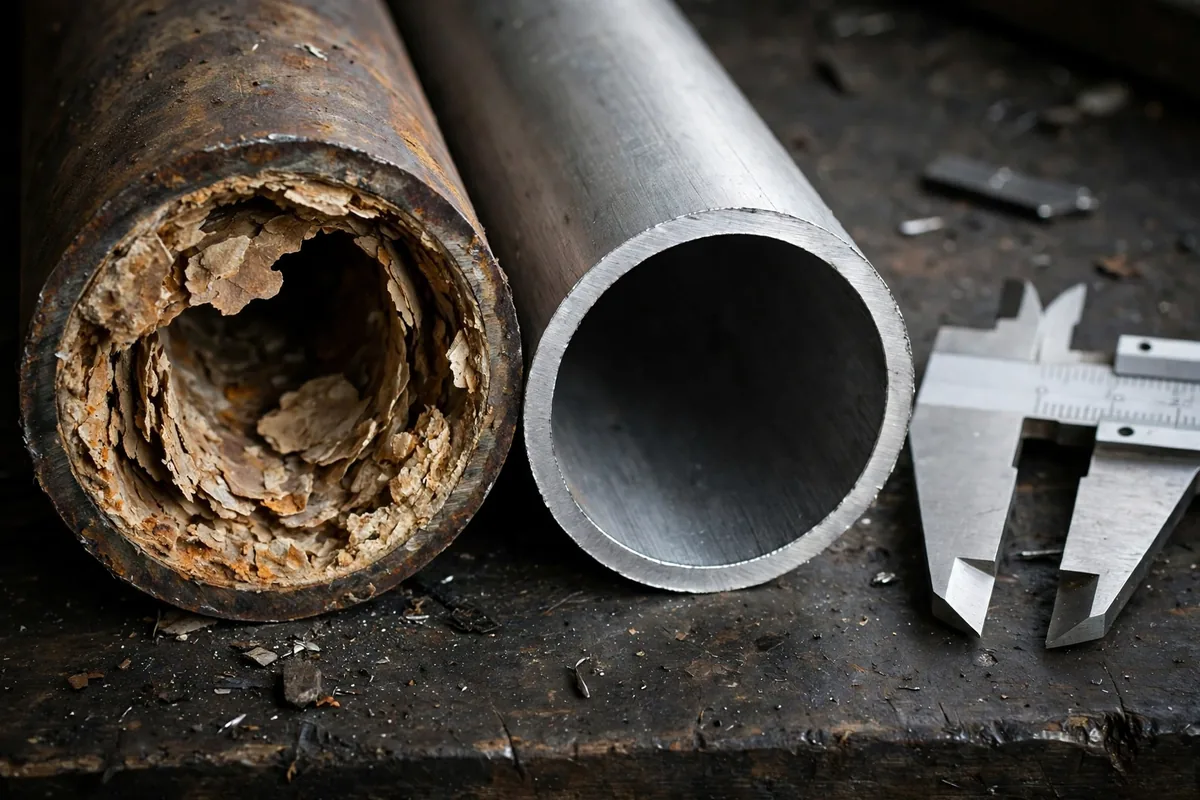
Read it like a core sample. Bright, full-thickness walls with a clean split: the run is sound and the section repair is honest. Walls thinned to foil at the edges, bore narrowed by scale, pitting freckled along the inside, a second bulge or hairline a hand's width from the first: the run is failing as a system, and patching the loudest spot leaves the quiet ones queued behind it. Pipe corrosion writes its verdict on the inside of the pipe, where only the cut reveals it.
This is why keeping the cut-out matters beyond curiosity. In Berwyn, IL, where the median home dates to 1938, pros hand the section to the homeowner as a matter of routine — the argument for whichever scope follows is sitting in the homeowner's palm, in cross-section.
Replace the spot when the spot is the story. Replace the run when the run is the story. The cut-out section tells you which story you are in.
Water Moving Where It Shouldn't?
One free call connects you with a local pro who can arrive in 30–60 minutes and find the burst without tearing the house apart first.
Call (800) 555-0100Four situations: the material is at end-of-life by type — galvanized steel pipe scaled through, polybutylene pipe brittle with age; the burst is the run's second failure (the trend rule: one is an incident, two are a pattern); the run is inaccessible enough that reopening it later costs more than renewing it now — inside a finished ceiling, under a slab; and the surrounding pipe, exposed during this repair, shows the same disease at the next joint along. In each case the section repair is not wrong exactly — it is a down payment on the next emergency.
The arithmetic is asymmetric: a section repair inside a failing run buys months; a replacement buys the run's full new lifespan and one opening instead of two. Pros in Akron, OH phrase it to homeowners as paying for the wall opening once.
Yes — staged scopes are often the wisest version. Section-repair tonight to restore water and stop damage, with the run's replacement booked as planned work within the season, priced calmly and done in daylight. Or replace the worst run now — the one that burst — and schedule condition checks on its same-era siblings rather than renewing everything at once. The main shut-off valve purchases control; the calendar purchases judgment.
What does not combine sensibly is a section repair presented as a cure for a run the pro knows is failing. If the cut-out shows disease, the honest conversation happens tonight, even if the replacement happens next month. The staging is a scheduling choice; the diagnosis is not negotiable.
Both, when the evidence is borderline: the section repair priced as one line (length removed, material, test included), the run replacement priced as another (route, material, access, restoration boundaries), and the pro's recommendation with the cut-out as its footnote. A quote that offers only the larger scope without showing the smaller one's price — or only the patch without mentioning the run's condition — is withholding half the decision.
Across Ohio, that two-line quote is the signature of a pro who expects to be checked. Ask for it in those terms: "price the section, price the run, show me the pipe." Three requests, and the fork in the road becomes a decision you actually own.
Finding the split is a kit job: an acoustic leak detection check along the run, a thermal imaging camera for the wet path behind drywall, a moisture meter to map how far the water travelled, and a pipe camera inspection where the line runs under the slab.
More straight answers about finding hidden bursts and what happens after you find one.
Still Have Questions? Call Free
A real person answers, day or night, and connects you with a local pro who can check the problem in person.
(800) 555-0100The damaged length plus a margin of sound pipe on both sides — typically enough to reach bright, full-thickness metal with room for clean joints. Freeze splits can run several inches past the visible opening, and corrosion thins beyond the hole, so the cut is guided by what the pipe's interior shows as it is opened. A repair that cuts exactly at the hole's edges is saving pipe at the expense of the joint's future.
The new section will; the question is the old pipe either side of it. A section repair's lifespan is the remaining life of the run it joins — in sound pipe, decades; in thinning pipe, until the next weak spot fails. That is the entire logic of the scope decision: the repair is only ever as durable as its neighbours, which is why the cut-out's condition matters more than the new piece's quality.
On the day, yes — more material, more labour, more access. Across the run's life, not necessarily: one replacement can cost less than two or three section repairs with two or three wall openings, two emergency call-outs and repeated damage risk. The comparison that matters is total cost over the years each scope buys, which is why the quote should show both scopes with their honest expected horizons.
Then access economics argue harder for certainty: if the run's condition is doubtful, replacing the run while the wall is open anyway avoids reopening finished work for the next failure. If the cut-out shows sound pipe, the section repair preserves your renovation. Either way, photograph the open wall and the pipe's route before it closes — the next trade who ever works there will bless you for it.
Yes — partial replacement to the next sound junction is a legitimate middle scope: renew from the failure to the nearest manifold, valve or material transition where the pipe beyond is demonstrably healthier. It suits runs whose damage is localised by a cause — one cold exterior wall section of an otherwise protected line, for instance. The junction choice should be explained in the quote, because it defines what was renewed and what was trusted.
Often, and deliberately: a failed galvanized or polybutylene run is usually renewed in PEX pipe or copper pipe rather than in kind, because the material itself was part of the failure. Mixed systems are normal and safe when joined with the right fittings and dielectric care at metal transitions. The quote should name the new material and why it suits your water, layout and freeze exposure.
A section repair is typically a single visit — hours, including testing and cleanup. A run replacement ranges from most of a day to a couple of days depending on access, length and restoration boundaries. Reroutes can be faster than in-place replacement under a slab because the new path avoids demolition. Your quote should carry a time estimate alongside the price; both are part of planning around a home without water.
That is your right — it is your house and your budget. A professional will do the repair properly, note the run's condition and the recommendation in writing, and leave you with the cut-out section. Keep that paperwork: it documents that the next failure was foreseen as a system issue, which matters for planning and for any later insurance conversation. Many homeowners stage it exactly this way and book the replacement within the season.
Insurers focus on the water damage and its mitigation rather than directing your plumbing scope; the pipe work itself is commonly treated as a maintenance matter. What they do value is documentation — the pro's written finding, photos, the kept cut-out — whichever scope you choose. If the run's condition contributed, that written record is the honest account of the event, so ask for it either way.
Reviewed By Hamza
Lead Plumbing & Emergency Pipe Repair Specialist
Hamza is a certified plumbing and pipe restoration specialist with extensive field experience diagnosing sub-zero pipe splits, thermal stress fractures, and slab leaks across harsh winter climates. He specializes in non-destructive leak localization, copper-to-PEX conversions, and preventative freeze-proofing to safeguard residential and commercial plumbing systems against catastrophic water loss.
Updated October 30, 2026
Holding a cut-out section and wondering which scope it argues for? One free call connects you with a local pro who can read the evidence with you and price both scopes in writing — section and run.
Free Call · Answered 24/7 · Local Pros Near You
Not sure how repiping works or what it involves exactly? One free call connects you with a local pro who can arrive in 30–60 minutes. Call now.

Not sure how repair burst copper pipe works or what it involves? One free call connects you with a local pro who can arrive in 30–60 minutes. Call now.